A Collaborative Approach to Smart Incontinence Care: Pilotfish, OrelTech and Partners
Smart incontinence products offer a more efficient and less intrusive way to monitor patient needs. However, high costs have limited their adoption. This collaborative project explores how new materials and design approaches can make these solutions more accessible

Article hightlights
• Smart incontinence products reduce the need for manual checks
• High system costs limit large-scale adoption
• Pilotfish and partners are developing a cost-effective solution
• Printed electronics enable more scalable production
The Challenge of Smart Incontinence Products
Smart incontinence solutions are emerging as a non-intrusive way to monitor patient needs in healthcare environments.
By connecting sensors to digital platforms, caregivers can track usage without performing frequent manual checks. This improves efficiency for medical professionals and reduces discomfort for patients.
Despite these advantages, adoption remains limited.
The main barrier is cost. Many existing solutions rely on components that are too expensive for widespread use in healthcare facilities.
A Collaborative Approach to Cost Reduction
This project brings together expertise in materials, engineering, and product development through a collaboration between Pilotfish, OrelTech, VTT, and Blumorpho.
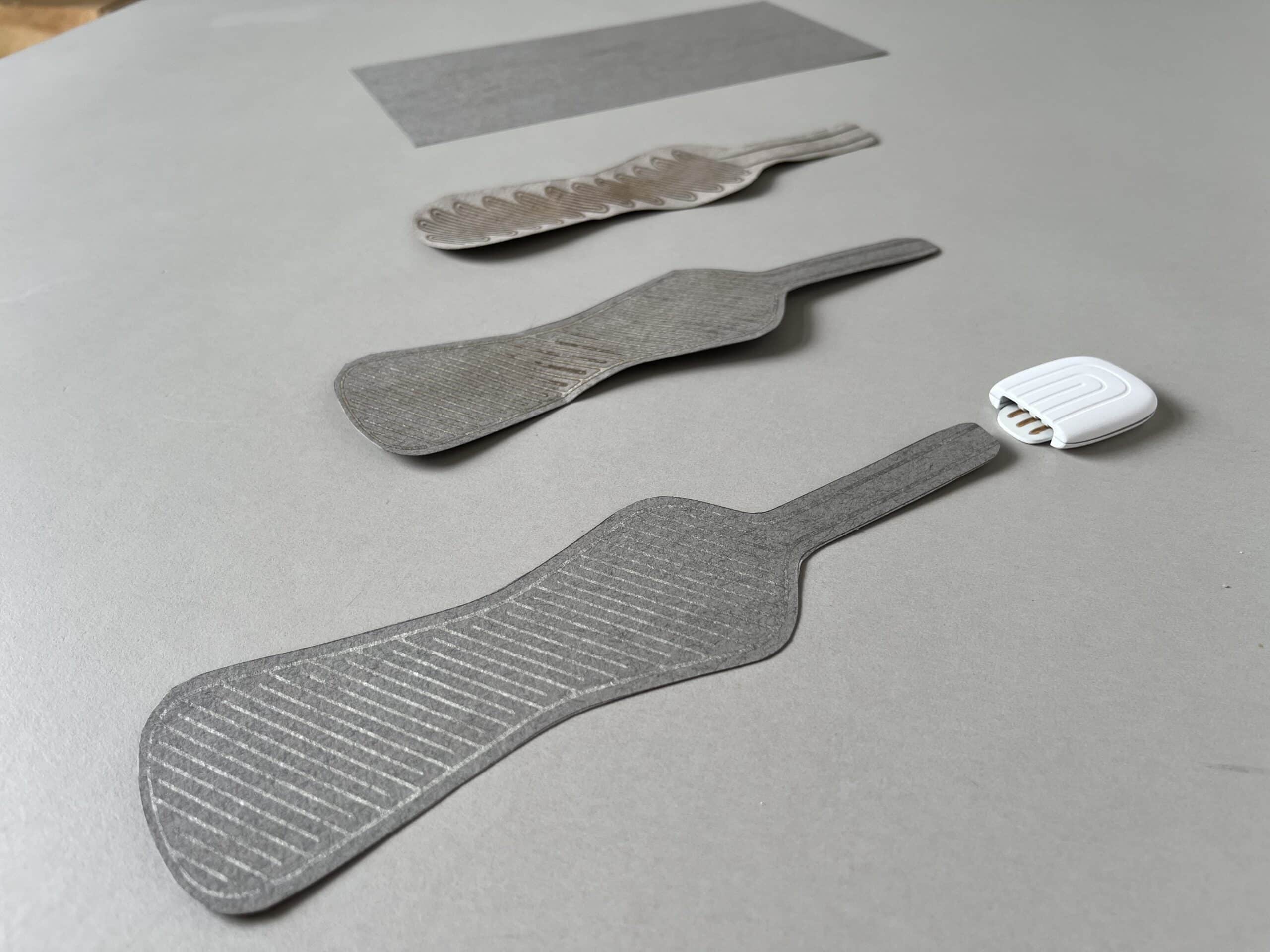
Pilotfish is developing a connector between the sensor and monitoring device, focusing on reducing system complexity and cost.
By rethinking this critical component, the team aims to make smart incontinence products financially viable for broader adoption.
“In healthcare, innovation only creates impact when it is accessible. Reducing cost without losing functionality is key to making these solutions viable in real-world settings.”
— Harm Hogenbirk, Managing Partner, Pilotfish
The Role of Printed Electronics
A key enabler of this approach is the use of printed electronics.
Through collaboration with OrelTech, conductive metallic inks can be applied directly to affordable materials such as paper. This removes the need for traditional metal components, which are often a major cost driver.
The result is a more flexible and scalable solution that aligns with the economic realities of healthcare providers.
From Concept to Prototype
The project has progressed from concept to prototype with support from a broader innovation ecosystem.
In addition to Pilotfish and OrelTech, partners include VTT and Blumorpho. The project is supported by the European Commission through Horizon 2020 funding under the SmartEEs programme.
This collaboration enables the integration of advanced materials, engineering, and product development into a practical and scalable solution.
Don’t miss what’s next in product development
You may also find interesting

Pilotfish Inc. Earns 2026 D&B SME Elite Award
Pilotfish has been selected as one of Taiwan’s Top 1,000 SMEs in the 2026 Dun & Bradstreet SME Elite Award (鄧白氏中小企業菁英獎), recognising Pilotfish Inc. among a select group of companies demonstrating sustained business performance, international competitiveness, financial soundness and long-term development potential.


From Prototype to Production: Why an Integrated Product Development Partner Makes the Difference
Discover why successful hardware products require more than great technology. Learn how an integrated product development approach reduces risk, accelerates time-to-market, and transforms prototypes into scalable, production-ready products.
Why wait months to launch?
From concept to production, we help teams bring products to market faster - without compromising quality or compliance.
What innovators often ask us?
This is some text inside of a div block.
Printed electronics using conductive metallic inks applied to low-cost materials.
This is some text inside of a div block.
A connector solution that reduces system cost and improves scalability.
This is some text inside of a div block.
High component costs have limited their adoption in healthcare environments.
This is some text inside of a div block.
They are sensor-based systems that monitor patient needs and reduce the need for manual checks.